News
MEDTEQ+ Member Interview: Meet David Rivest-Hénault, core researcher of the VitalSeer Project at the National Research Council of Canada
January 12th, 2026
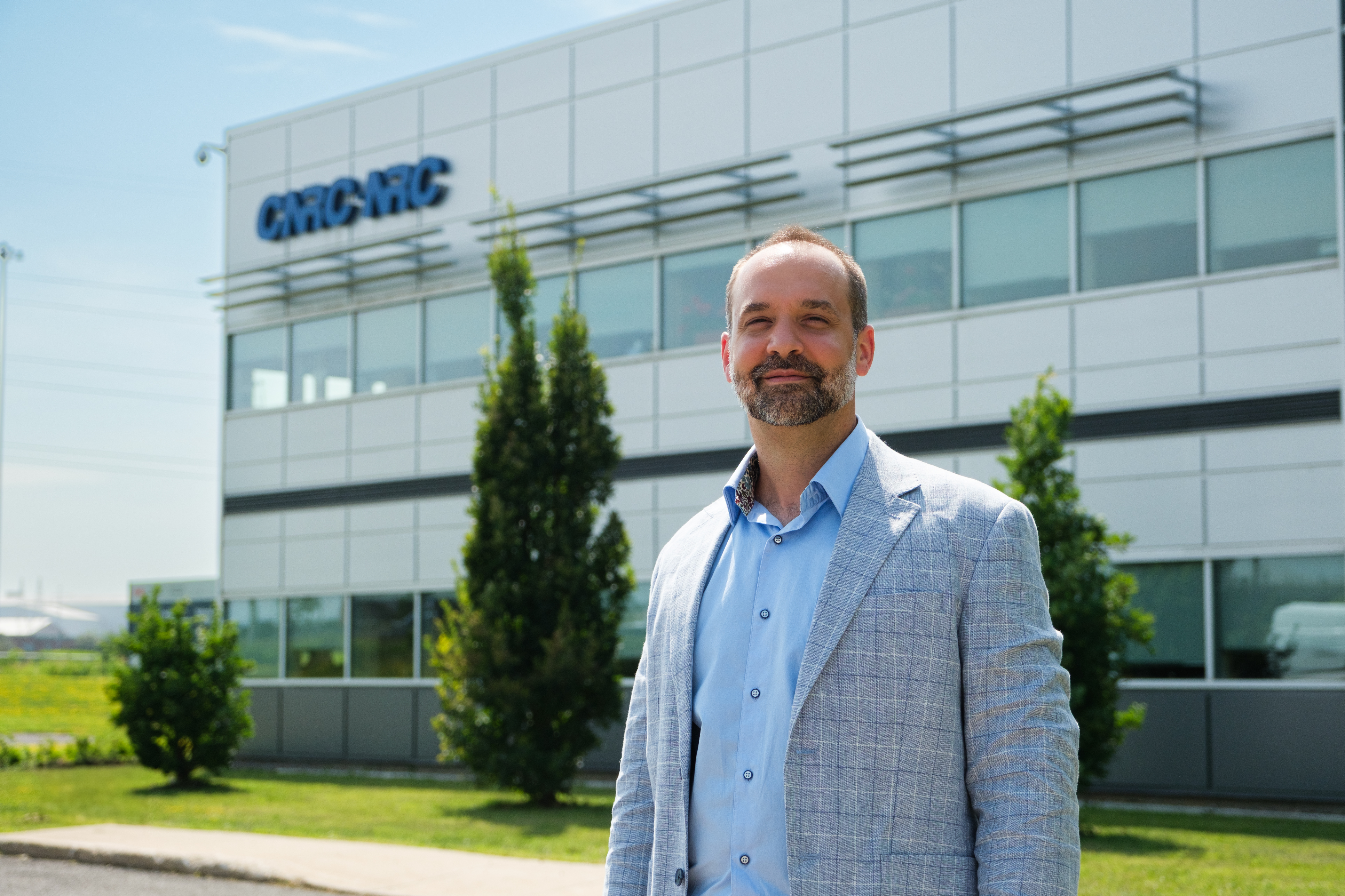
David is truly passionate about his work: a researcher at the National Research Council of Canada (NRC) for nearly 10 years, he always knew he wanted to be an engineering scientist—even as a child. Curious, ambitious, and rigorous, David is an associate researcher in an innovative team responsible for the VitalSeer project, a solution for contactless health assessment. “Contactless assessment” refers to the processes by which physiological signals are obtained from contactless equipment (a microphone or video camera) and processed to extract vital signs or other crucial information about the patient’s health. Portrait of a committed researcher for whom work is a matter of passion and reason.
The Story of David and his Academic Research Interests
Originally from the Quebec City area, he initially studied mechanical engineering at Cégep. He then moved to Montreal to pursue a bachelor’s degree in automated production engineering at the École de technologie supérieure (ÉTS). During his studies at ÉTS, David had the opportunity to study in England. During this pivotal year for his future career, he felt that he had the support of two professors in particular. “My professors made me realize that I was really cut out to be a researcher because of the way I think, analyze, and express myself,” he says humbly.
Back in Quebec, David worked for five years at a young start-up company that specialized in developing a robot—an inspection platform for sewer and aqueduct quality issues. He began his master’s degree in automated production technology at ÉTS and went straight on to a doctorate in engineering, specializing in computer vision. He quickly developed a keen interest in the medical field. In 2010, he did an internship at Siemens Corporate Research in Princeton, where he used 2D fluoroscopy (a form of X-ray imaging) to create an augmented representation in which the 3D model is precisely superimposed on the anatomical structures visible on the fluoroscopy. The 3D model thus makes it possible to visualize the location of structures invisible to X-rays during an operation.
David then completed his thesis and accepted a job in Australia, where he continued to work on medical imaging. “For me, the common thread is the challenge of taking something new that I can perfect with the computer. That’s really what drives me,” he explains with a smile. After three years, David saw a job posting at the NRC and applied from Australia. Today, nearly 10 years after joining the NRC, he is a research officer in the Remote Biosensors team of the Digital Health and Molecular Technology Directorate at the Medical Devices Research Centre .
Developing the VitalSeer project at the NRC’s Digital Health and Molecular Technology Laboratory
Since David specializes in medical imaging, he is looking to develop technology that could lead to better diagnostics while being easily accessible. When his team leader came up with the idea of assessing patients’ vital signs without contact using computer vision and remote biosensors, David quickly became one of the key minds behind the project. Then, in early 2019, David presented a first prototype during the Centre’s evaluation by an external audit committee. The committee immediately expressed enthusiasm for the concept.
Then the 2020 pandemic hit, and interest in the VitalSeer project was more than piqued: it was now vital. “We quickly put together a research team to work on the project. The context meant that everything accelerated and we were finally able to create a contactless platform technology using cameras that measure heart rate, respiratory rate, and blood oxygen saturation from short video captures,” David explains, talking about VitalSeer.
VitalSeer’s cutting-edge technology will make it possible to serve remote populations and remote areas across Canada. It supports all demographics and is based on rigorous scientific testing. In the future, VitalSeer could help some patients avoid unnecessary visits to hospital emergency rooms for an initial assessment of their vital signs.
MEDTEQ+ administers funding for the Quebec-based Organizational Support Program (PSO), which co-funds collaborative industrial research and development projects in the medical technology sector on behalf of the Ministry of Economy, Innovation, and Energy (MEIE).
“VitalSeer: Optimization and clinical deployment of a remote vital signs monitoring platform” is a collaboration between the NRC, JRAS Medical Inc. (JVPLabs), Novatek International, and MEDTEQ+, with co-funding from MEDTEQ+ and the NRC.
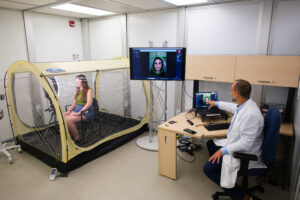
Laboratory validation of the VitalSeer software. The hypoxic tent, which reduces the oxygen level in the air, allows observation of changes in oxygen saturation (SpO2) in a volunteer.
Thank you to David, Di, and the entire team at the NRC Medical Devices Research Centre for your hospitality. Our team is proud to collaborate with you on the VitalSeer project, and it is always a pleasure to visit.
“Since 2014, the NRC, including the Medical Devices Research Centre, has been a proud partner of MEDTEQ+, with whom we share a common vision of advancing the Canadian economy through innovative technologies in the health sector. This long-standing collaboration is based on sustained and mutually enriching exchanges. Among other things, it has allowed us to explore new scientific avenues, particularly in the field of emerging technologies and to develop innovative tools that meet the evolving needs of the healthcare sector.”
– Di Jiang, Research Officer and Team Leader, Remote Biosensors and Medical Devices, NRC Medical Devices Research Centre
About MEDTEQ+
MEDTEQ+, a pan-Canadian consortium for industrial research and innovation in healthcare technologies, aims to accelerate the development of innovative technological solutions to improve people’s health and quality of life. MEDTEQ+ supports the validation of these technologies, their integration into the healthcare network, their commercialization, as well as their local and international outreach, by bringing together the complementary skills of industrial and institutional partners and healthcare providers. MEDTEQ+ offers support, subsidies, and investment services to innovative companies. Since December 2022, MEDTEQ+ has also been the lead partner in the envisAGE initiative, which aims to catalyze the AgeTech ecosystem and help companies grow and scale in the AgeTech market. MEDTEQ+ relies, among other things, on financial support from the Government of Quebec, the Government of Canada, the private sector, and complementary partners to foster research-industry relationships. www.medteq.ca/
Share


